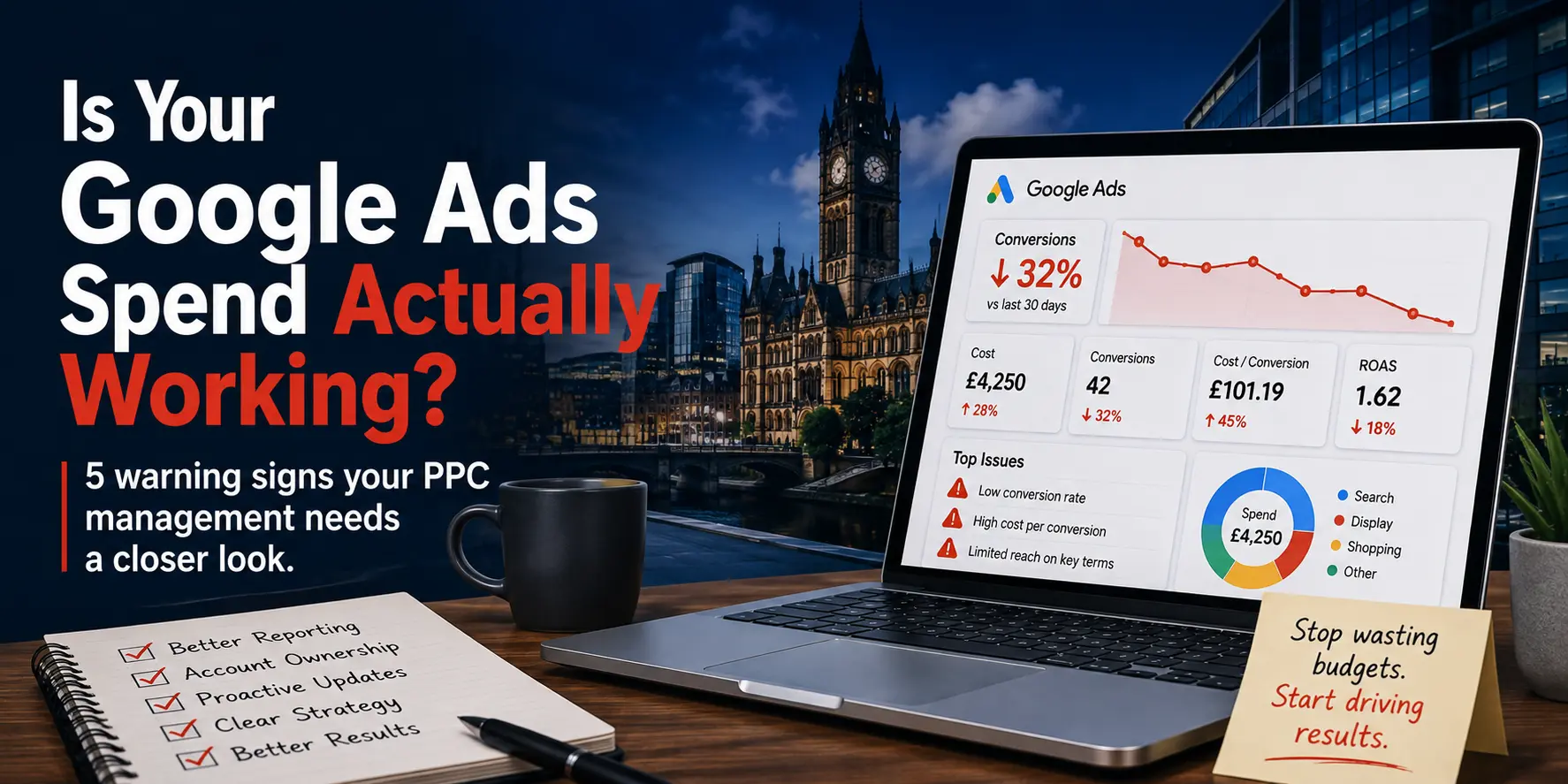
Is Your Manchester Business Wasting Google Ads Spend? Here’s How to Tell

If you’re a business running Google Ads through an agency and something feels off, spend going up without results following you’re probably not imagining it. Most businesses don’t switch PPC agencies because of one dramatic failure. It’s usually a slow build-up of small red flags they kept excusing while the budget quietly left the account. Here’s what those red flags actually look like in practice.

Your reports don't tell you anything useful

Most agencies will happily show you clicks, impressions, and click-through rate every month. The problem is these are activity metrics they prove a campaign is running, not that it’s working. If you finish every monthly call unable to say what your actual cost per lead or cost per sale was, that’s not a “you” problem, it’s a reporting problem. A PPC manager who’s actually accountable for results will report in terms that connect directly to your business cost per acquisition, conversion rate, return on ad spend in language you can act on rather than words that sound impressive and say nothing. When a report leans heavily on reach and engagement without a clear number tied to money made or saved, it’s often because the real numbers aren’t strong enough to lead with.

Nothing in your account seems to change

Google Ads accounts need continuous attention, new ad variations to test, refined targeting as your audience shifts, negative keywords added as junk traffic reveals itself, bids adjusted as the market moves. If you look at your account and the structure is identical to how it looked six months ago, with the same ads still running and the same keyword lists untouched, it isn’t being actively managed. It’s running on autopilot while you’re billed as though someone’s driving.
Worth asking directly: what’s actually changed in the account over the last quarter, and why. A confident agency will have a clear answer, usually backed by a testing log or change history they can show you on request. A vague one usually means there isn’t one which is often a sign the account has been quietly deprioritised in favour of newer, larger clients.

You've become the one chasing updates

A properly managed account should generate proactive communication, a heads-up when spend spikes unexpectedly, when conversions drop, when a competitor starts bidding aggressively on your core terms. If every update only happens because you emailed asking what’s going on, the relationship has quietly inverted: you’re managing them, not the other way round.
This matters more in a competitive market, where local competitor activity can shift your cost-per-click fairly quickly: a new competitor entering your search terms, a seasonal push from an established player, or simply more businesses discovering paid search works for their industry. A reactive agency means you find out about the damage after it’s already cost you money, not before. A proactive one flags the shift and adjusts strategy before it shows up as a bad month on the invoice.

They struggle to explain their own decisions

Ask why a campaign has the daily budget it has, or why a particular set of keywords is being targeted, or why a certain landing page was chosen for a given ad group. Someone who genuinely built and understands your strategy can explain the reasoning in plain terms, because deliberate PPC management involves constant, explainable decision-making; it isn’t automated guesswork left to run itself.

If the answer is vague, defensive, or amounts to “that’s just how we’ve always done it,” that’s often a sign the original strategy was never fully thought through, or that whoever’s currently on your account didn’t build it and doesn’t fully understand it either. Account handovers happen often in larger agencies as staff move between clients, and each handover is a chance for institutional knowledge to quietly get lost.

You don't actually own your own account

This is the one businesses tend to discover far too late, usually the exact moment they try to leave. It’s worth checking directly: is your Google Ads account under your ownership, with your own billing and login access, or does it live inside the agency’s own management structure?

Without direct ownership, switching agencies can mean losing your account history, your conversion tracking data, and months or years of accumulated testing effectively starting again from zero with whoever you hire next. If a prospective agency is vague or hesitant on this question, treat that hesitation as information in itself.

What switching actually looks like

Switching PPC agencies sounds riskier than it usually is, provided you have ownership of your account. A competent new agency should be able to review your existing account, understand what’s already been tested, and build on that not tear it down and start over out of habit, which wastes the learning your ad spend already paid for.

For businesses considering a change, the first conversation shouldn’t cost anything. A proper audit of your current account looking at reporting quality, testing history, and account ownership will usually make clear within an hour whether these issues are actually present, or whether the problem lies somewhere else entirely.

The honest takeaway

None of this, on its own, is necessarily a reason to walk away immediately reporting can improve, communication gaps can be raised directly with your current agency first. But when you’re noticing several of these at once, particularly unclear reporting combined with an account that hasn’t meaningfully changed in months, that’s less an occasional lapse and more a pattern. And patterns are worth acting on before another quarter of spend goes the same way.

If you’re a Manchester business unsure whether your current setup falls into any of the above, Hotbit Digital offers a free, no-obligation audit of your existing Google Ads account and a straightforward look at your reporting, testing history, and account ownership, with no pressure to switch. Sometimes the answer is your current agency’s doing fine and something else is going on. Sometimes it isn’t. Either way, you’ll actually know.
Frequently Asked Questions

How do I know if my PPC agency is underperforming?
Start with whether you actually understand your own monthly reports, whether your account shows real evidence of ongoing testing, and whether you have direct ownership of your Google Ads account. Struggling on more than one of these is a genuine warning sign.
Is it risky to switch PPC agencies?
Not if you own your Google Ads account and its history. A competent new agency can review what’s already there and build on it rather than starting from scratch.
How often should a PPC agency actually update my campaigns?
There’s no fixed schedule, but an account with no visible change to ad copy, targeting, or keyword lists over several months usually isn’t being actively managed, whatever you’re being billed for.
What should I ask before switching PPC agencies?
Confirm you have full ownership of your existing account and its data first, then ask a prospective new agency to audit it and explain specifically what they’d change and why.
Do I lose my ad history if I switch agencies?
Only if your current agency owns the account rather than you. With direct ownership, your history and tracking data carry over to whoever manages it next.